
Wet spun linen yarn is linen yarn spun from long line flax roving that passes through a hot water bath at 60–70 °C immediately before drafting. The heat softens the pectin that binds the fiber bundles, so flax that has been hackled, drawn and roved can be wet spun into a smooth, strong, low-lint yarn that holds as warp.
Seven counts, Nm 4 to Nm 18, spun in our own mill
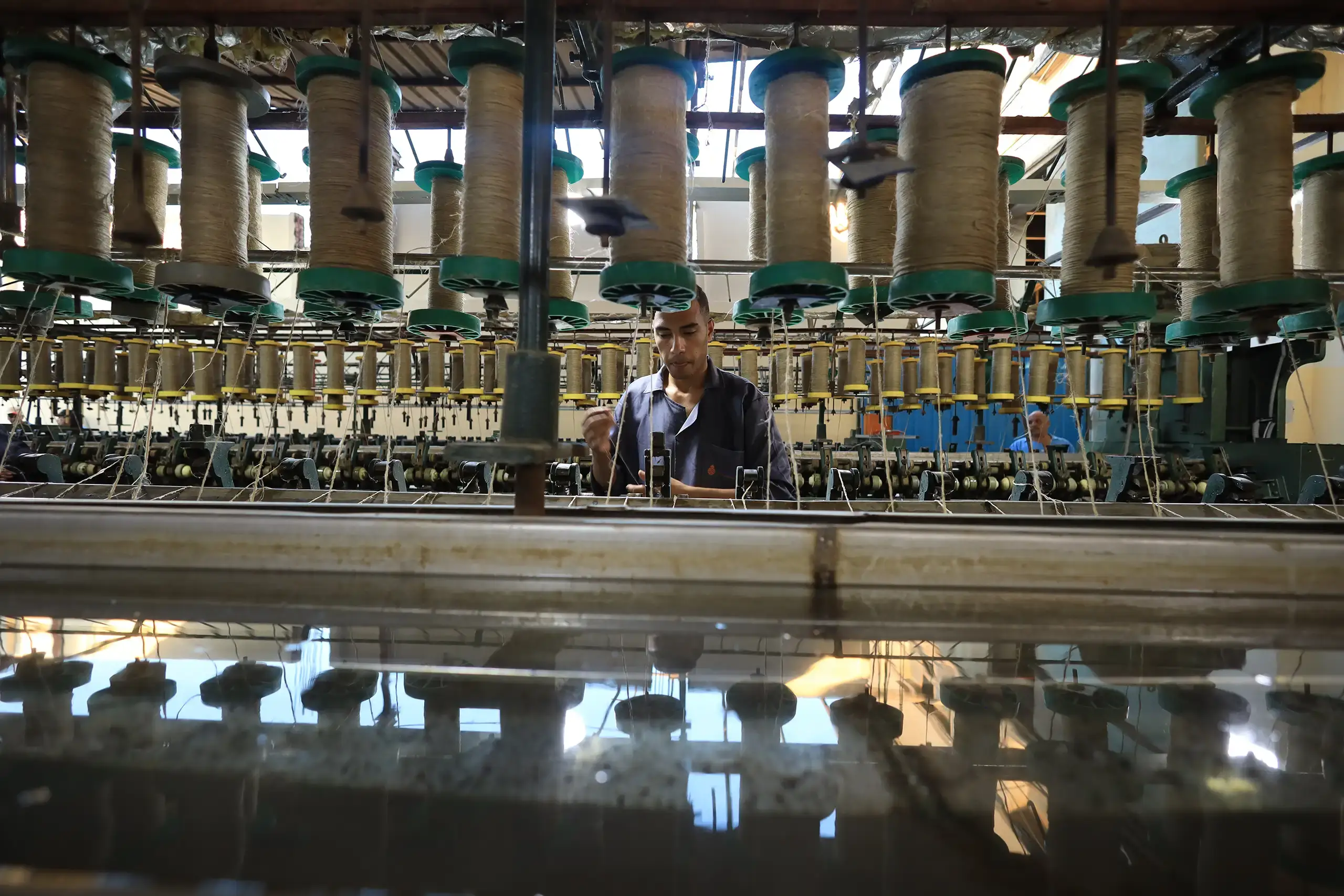
We wet-spin long line flax fiber into linen yarn for weaving and knitting, from Nm 4 to Nm 18, in singles or plied, natural, bleached, or dyed to any Pantone reference. Counts Nm 4 to Nm 12 are spun from Egyptian long line flax; Nm 16 and Nm 18 from European flax fiber of Belgian origin.
Every count below is published with its metric and imperial equivalents — because a weaver working in 16/2 cannot compare a metric count to what is already on the loom. Most mills publish a range and a certificate. We publish the numbers.
Tell us the count and the end fabric. We send a sample with its technical data and a real lead time.
WhatsAppRequest a sample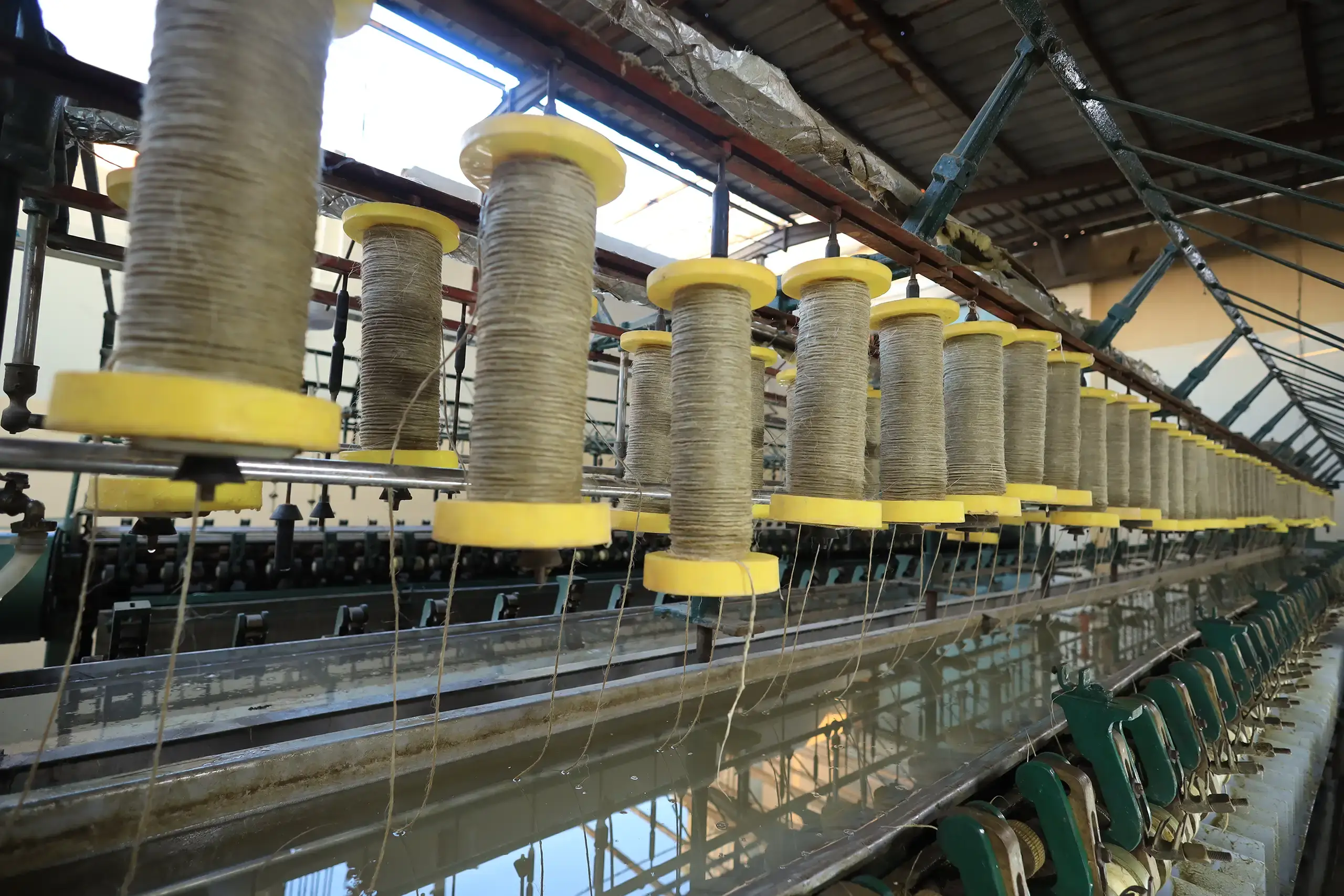
Linen yarn for weaving: counts, equivalents and recommended use
Available as singles or plied, in natural, bleached or dyed. Yards per pound is the singles figure — for a 2-ply, halve it.
| Count | Meters / kg | Yards / lb | Typical use | Fiber |
|---|---|---|---|---|
| Nm 4 | 4,000 | 1,984 | Heavy plains and twills, upholstery grounds, canvas, flat-weave rugs | Egyptian long line flax |
| Nm 6 | 6,000 | 2,976 | Rug and tapestry warp, canvas, heavy furnishing | Egyptian long line flax |
| Nm 7.5 | 7,500 | 3,720 | Tapestry, durable jacquards, technical cloth, high-use interiors | Egyptian long line flax |
| Nm 9.5 | 9,500 | 4,712 | General weaving warp, balanced plain weaves, home textiles | Egyptian long line flax |
| Nm 12 | 12,000 | 5,952 | Curtains, table linens, quick-dry towels, balanced plain weaves | Egyptian long line flax |
| Nm 16 | 16,000 | 7,937 | Shirts, dresses, scarves, refined apparel-weight yardage | European flax, Belgian origin |
| Nm 18 | 18,000 | 8,929 | Fine shirting and refined yardage with a smooth hand | European flax, Belgian origin |
Not sure which count matches your cloth? Request a sample →
Nm is the metric count: how many 1,000-meter lengths make one kilogram. A higher number is a finer yarn. We give yards per pound alongside it because that is the one figure that converts across every counting system a weaver might be using.
How wet spun linen yarn is made: linen yarn production in four stages
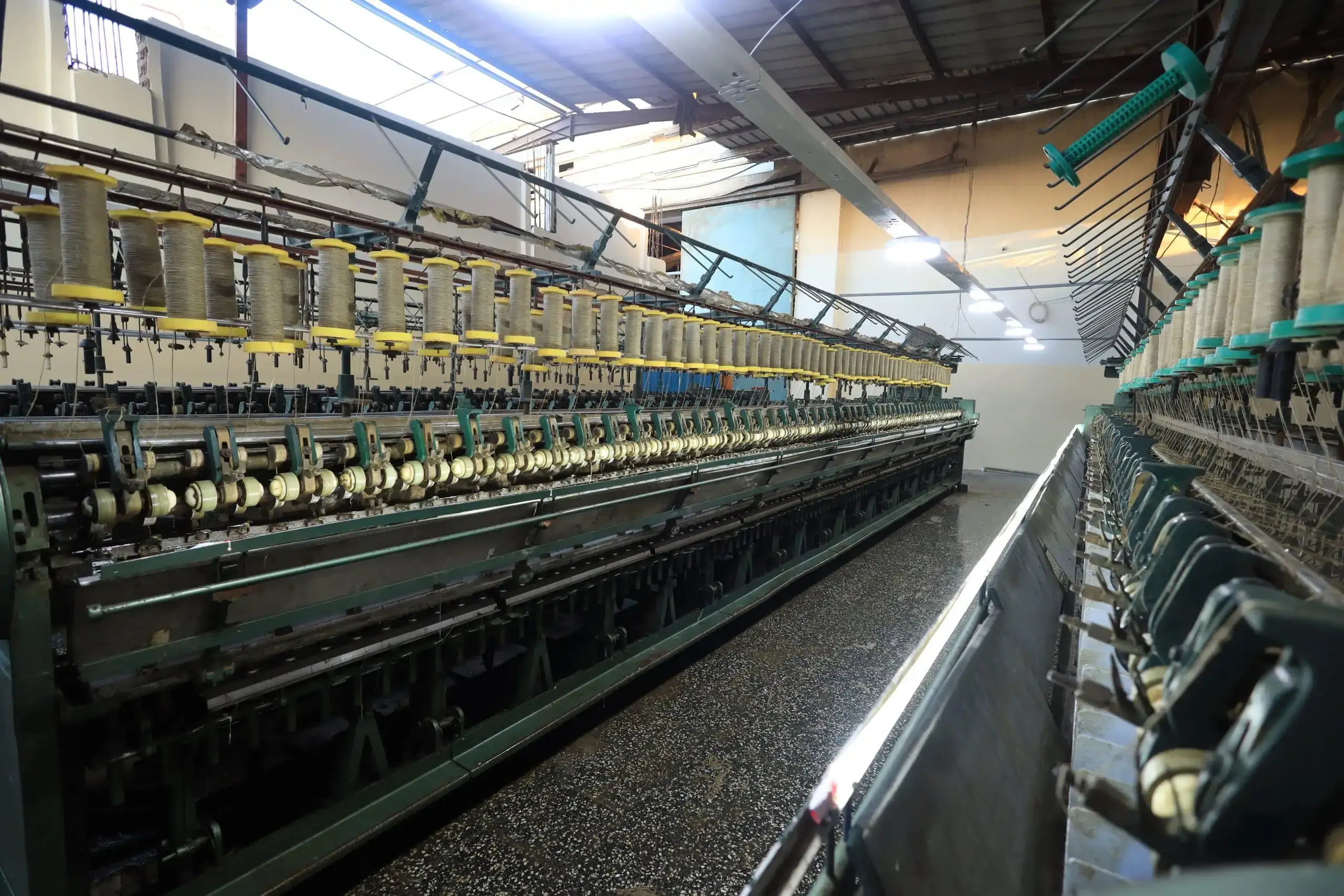
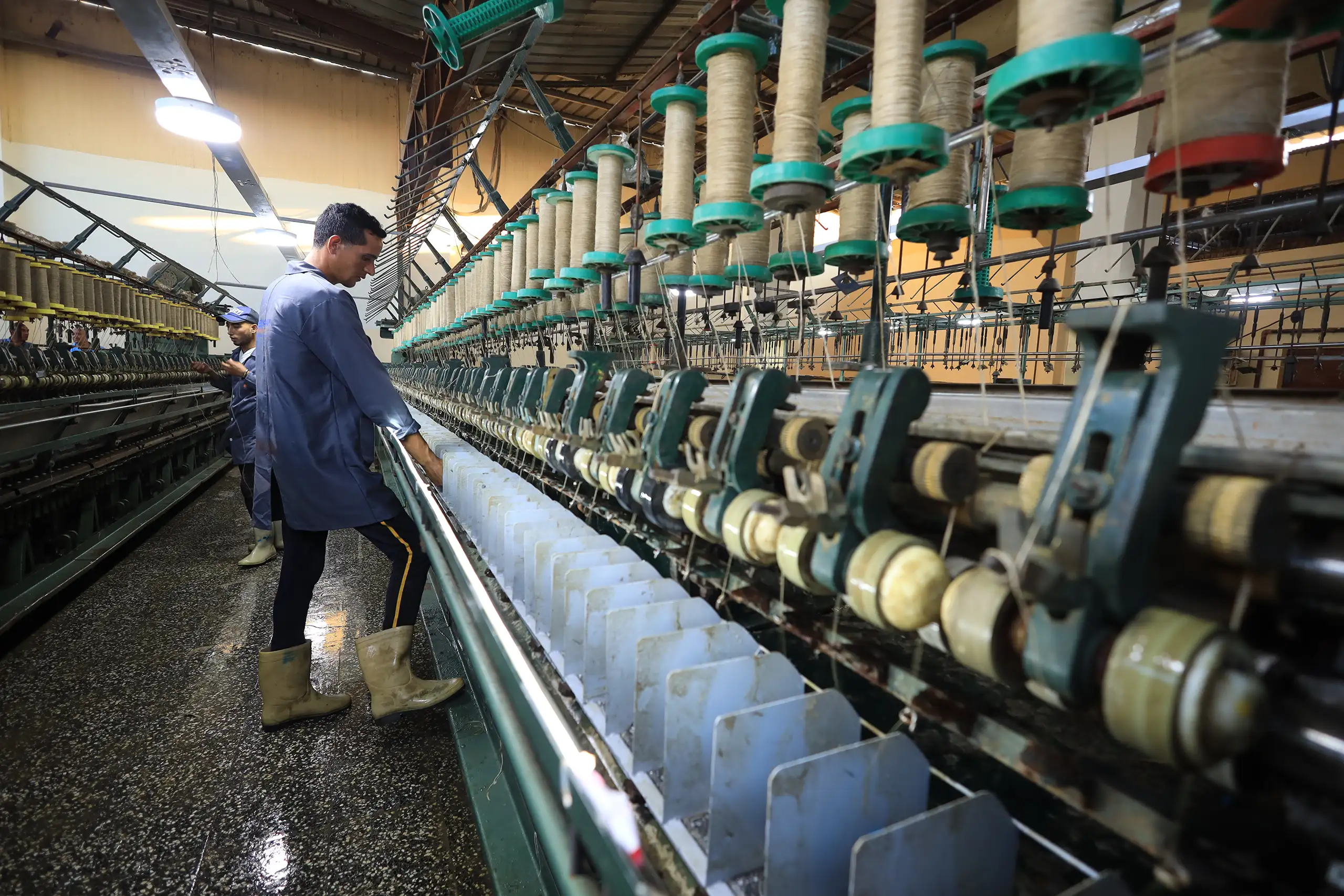
Wet spinning is what separates weaving-grade linen from twine. The line flax fiber roving passes through a hot water bath at 60–70 °C immediately before the drafting rollers. The heat softens the pectin — the natural gum that binds the flax fibers into bundles — so the bundles split into finer individual fibers and slide past one another instead of breaking.
The four stages, start to finish
| Stage | What happens |
|---|---|
| Hackling (combing) | Flax is combed to pull out short fiber and impurities, leaving only the long, high-quality flax fibers. This is the step that decides how fine a count can be spun. |
| Drawing | The fiber passes through several drawing stages that align it in parallel and even out thick and thin places, which is what gives the finished yarn its consistency. |
| Roving | A light twist is inserted to hold the strand together and prepare it for the spinning frame. |
| Wet spinning | The roving passes through the 60–70 °C bath and is drafted immediately, producing compact, uniform, low-lint yarn. |
The three things heat changes
- Fiber bundles separate. Softened pectin lets a bundle divide into finer elements, so a much finer yarn can be spun from the same flax.
- The surface lies flat. Fibers are drawn parallel and stay there as the yarn dries, which is where linen's smoothness and lustre come from.
- Fewer protruding ends. That is why wet-spun yarn is smooth to the hand while dry-spun yarn is hairy — and why it survives the abrasion of a reed and heddles as warp.
Flax is one of the few fibers that gets stronger when wet — up to about 20% higher tensile strength. Combined with near-zero elasticity, that is what makes wet-spun linen a dependable warp: it does not stretch, so the sett you calculate is the sett you weave.
Wet spun vs dry spun linen yarn
Both start as flax. The difference is one water bath — and it changes what the yarn can be used for.
| Wet-spun | Dry-spun | |
|---|---|---|
| Fiber used | Long line flax (hackled) | Tow (short fiber, comber waste) |
| Bath | 60–70 °C before drafting | None — spun dry |
| Surface | Smooth, lustrous | Hairy, matt |
| Fineness attainable | Fine — to Nm 18 here, finer elsewhere | Coarse only |
| Suitable as warp | Yes | Rarely |
| Typical end use | Apparel, table and bed linen, upholstery, fine furnishing | Twine, sacking, rope, coarse canvas |
Everything on this page is long line flax yarn, wet spun from the long, hackled fiber — not tow. If you need dry-spun tow yarn, we can quote it, but it is a different product for a different job.
Want to feel the difference before you warp? Request a sample →
What the finished yarn does on the loom and in the cloth
Linen warp yarn in 8/2, 16/2 and 20/2: what to order
Hand-weaving suppliers count linen in lea (NeL), not Nm, and the two systems do not translate at a glance. So the table leads with the lea count you already weave and gives the nearest Nm equivalent we spin, using yardage figures rather than labels:
| If you weave | Roughly | Closest count we spin |
|---|---|---|
| 16/2 (≈ 2,700 yds/lb) | Nm 5.4, 2-ply | Nm 6, 2-ply — 2,976 yds/lb singles |
| 8/2 (≈ 1,350 yds/lb) | Nm 2.7, 2-ply | Nm 4, 2-ply is the nearest we spin |
| 20/2 (≈ 3,000 yds/lb) | Nm 6.0, 2-ply | Nm 6, 2-ply |
Lea-based counts vary between suppliers, and a 2-ply yarn's grist is not exactly half the singles figure once twist take-up is counted. Use the table to identify the right sample to ask for — then weave the sample before committing a warp.
Natural, bleached, or any Pantone you name
We do not sell a fixed palette. We dye to your reference.
- Natural (greige) — undyed, the flax's own color, varying slightly by fiber lot.
- Bleached — half or full bleach, depending on how white you need the ground before dyeing or weaving.
- Dyed — any Pantone reference, minimum 30 kg per color. Below 30 kg we can supply natural or bleached only.
Most European spinners sell named, seasonal ranges with a fixed card. That works if one of their colors is your color. If it is not, a 30 kg custom lot is usually the difference between making the fabric and not making it.
Finishing, put-up and packaging
| Option | What we offer |
|---|---|
| Bleaching | Half or full bleach for a clean, bright ground before dyeing or weaving. |
| Dyeing | Any Pantone reference, minimum 30 kg per color. No fixed card. |
| Polishing | Extra surface smoothing for added sheen where the fabric calls for it. |
| Twist | Twist adjusted to balance strength against drape — firmer for warp, softer where hand matters. |
| Winding & put-up | Cones, balls or spools. Mills usually take cones; studios often prefer balls or spools. |
| Packaging | Export-ready packing for both air freight and container shipment. |
Tell us the end fabric and we will recommend the twist and finish rather than leaving you to guess — that is the part of being a flax yarn supplier that does not show up on a spec sheet.
Quantities, shipping and lead time
You do not have to commit a container to start. The route scales with the order.
| Stage | Quantity | Route | Color |
|---|---|---|---|
| Sample | Sample lengths | Courier | Natural or bleached |
| Trial order | From 20 kg | Air freight | Natural or bleached |
| Color trial | From 30 kg per color | Air freight | Any Pantone |
| Production | Bulk | Sea freight, full containers | Any Pantone |
Spinning is done in our own mill, under an ISO 9001:2015 quality system, in operation since 1974. Lead time depends on count, color and current loading — tell us the quantity and we will give you a real date rather than a range. Our certifications and test documentation are available on request.
A linen yarn manufacturer for mills, studios and hand-weavers
The same premium linen yarn for weavers goes to industrial mills running containers and to artisan studios ordering 20 kg. Weavers, knitters and designers use the finer counts for clothing, garments and scarves; furnishing manufacturers take the coarse end as linen yarn for upholstery, rugs and interiors; and crafts and studio-weaving communities buy across the range. If you are unsure which count suits your cloth, tell us the fabric and we will point you to it.
Quality control and traceability
Every batch is tested for count consistency (ISO 2060 skein method) and strength before it leaves the mill. Batch testing records are kept under an ISO 9001:2015 system, and each lot is traceable to its fiber source. Counts are held to international weaving standards, because a warp that drifts half a count between cones is a warp that stops the loom.
We have been a linen yarn manufacturer since 1974, spinning in our own mill rather than factoring someone else's yarn. That is what lets us answer a question about a specific count the same day. Whether you are a mill sourcing from a weaving linen yarn supplier by the container or a studio looking for a knitting linen yarn supplier at 20 kg, you are dealing with the people who spun it.
Questions weavers and mills ask us
?What is wet-spun linen yarn?
?What counts do you spin?
?Is the flax European?
?Can you match a specific color?
?What is the minimum order?
?I weave in 16/2 — what should I order?
?Can wet-spun linen be used as warp?
?Do you sell to hand-weavers as well as mills?
Trade publications, sourcing platforms and textile partners may request these images through our linen yarn image licensing page, crediting El Nawawy Company.
Tell us the count, the ply and the color
We will send a sample with its technical data and a real lead time. If we cannot spin what you need, we will say so rather than substitute something close.
WhatsApp usEmail the millAll contact options